


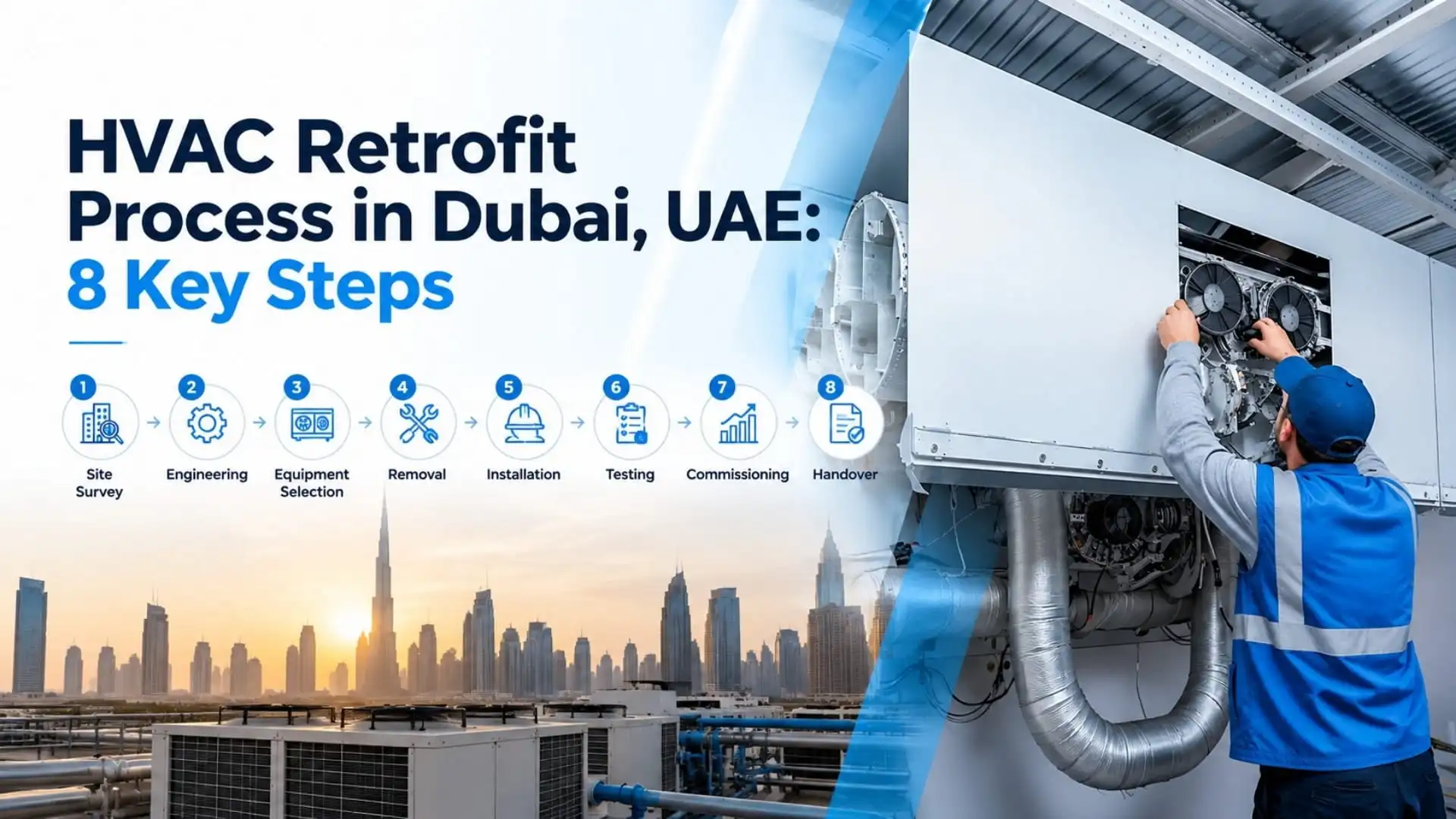
HVAC Retrofit Process in Dubai, UAE: 8 Key Steps
Chiller systems in Dubai across the UAE run almost all year and push hard through the summer months, when temperatures regularly pass 40°C. For many commercial, hospitality and industrial buildings, that means the HVAC system is the biggest single energy cost. When the equipment is a decade or more old, it is also the biggest source of waste.
An HVAC retrofit in Dubai upgrades the parts that are holding performance back instead of rebuilding the whole plant. A well-executed retrofit can cut HVAC energy consumption by 20–40% while extending equipment life. But the result depends on how the project is run. Here is how a structured, low-disruption HVAC retrofit works in UAE, step by step.
What are the steps in an HVAC retrofit in the UAE?
An HVAC retrofit in UAE follows eight steps: site survey, engineering, equipment selection, removal, installation, testing, commissioning and handover. Each step builds on the one before it, so the building stays operational and the new system performs as designed.
Step 1: Site survey
Every HVAC retrofit at Waha Air starts with understanding your existing system. Engineers inspect chillers, rooftop units, air handling units (AHUs), fan coil units (FCUs), ductwork and controls. They record equipment age, condition, capacity, operating patterns, airflow rates, chilled-water temperatures and energy consumption.
These measurements help identify whether poor performance stems from ageing equipment, incorrect controls, maintenance issues or a combination of factors. In the UAE, the survey also evaluates region-specific factors such as dust loading on coils and filters, heat exposure on rooftop units, and whether cooling is supplied by a district cooling provider or a central plant. The findings set the baseline for everything that follows, including the savings estimate.
Step 2: Engineering
With the survey data, engineers design the solution. This includes load calculations, system layout, and a plan for how new equipment will connect to existing piping, ducts and power.
Approval requirements vary depending on the building's location, the scope of the retrofit and the systems being modified. Projects may require permission from the building owner or owners' association, the master developer or the relevant authority, including Dubai Municipality, Dubai Development Authority or DEWA in Dubai, and the equivalent authorities in other emirates. These requirements should be confirmed during the engineering stage, before installation begins.
Good engineering also produces a phasing plan, so tenants and operations are disturbed as little as possible.
Step 3: Equipment selection
Equipment is chosen to match the building's real load, not just the nameplate of what was there before. Typical choices include:
- High-efficiency chillers and inverter-driven compressors
- Replacement AHUs and FCUs
- VRF systems for zones that need flexible control
- Smart building management systems (BMS) in place of outdated controls
Selection balances efficiency, reliability, local spare-parts support, lead times and refrigerant type. In Dubai, equipment rated for high ambient temperatures is a key consideration.
Step 4: Removal
Old equipment is carefully isolated, drained and removed. Refrigerants must be recovered and handled responsibly, and the work is planned around building hours. In occupied buildings, removal is often phased by zone or floor, and noisy or disruptive work is scheduled after hours.
Step 5: Installation
New equipment is installed, and piping, ductwork and electrical connections are completed. Ductwork that was leaking or poorly configured can be sealed, insulated or modified at this stage, which removes pressure losses that quietly waste energy every hour the system runs. Controls are installed and wired in so the new equipment can talk to the building management system.
Step 6: Testing
Before the system is switched over fully, each component is tested: pressure tests on pipework, leak checks, electrical checks, and airflow and water-flow measurements. Problems are far cheaper to fix at this point than after handover.
Step 7: Commissioning
Commissioning is where the retrofit proves itself. Our HVAC engineers balance airflow and water flow, set up and tune controls, verify sequences of operation, and confirm that the system delivers the design performance. A system that is installed but not properly commissioned will rarely achieve its expected savings, so this step is never worth cutting short.
Step 8: Handover
The project closes with documentation: as-built drawings, equipment data, test and commissioning reports, warranties and operating guidance. Your facilities team is briefed on how to run the new system, and a maintenance plan is agreed. This is also when you set up monitoring, so savings can be tracked against the baseline from the original survey.
HVAC Retrofit Services in Dubai, UAE
- Rooftop replacement: High-efficiency units built for UAE heat
- Chiller replacement: Efficient, correctly sized cooling plant
- AHU replacement: Better airflow, filtration and efficiency
- FCU replacement: Steadier temperatures, quieter operation
- VRF upgrade: Improved zone control and part-load efficiency
- Control system upgrade: BMS monitoring and early fault detection
- Duct modification: Less air leakage, pressure loss and heat gain
- Testing & commissioning: Verified, design-level performance
How long does the HVAC retrofit process take in the UAE?
It depends on the scope. Replacing a single AHU is a very different job from upgrading a full chiller plant. After the site survey, you should receive a detailed programme with phasing and milestones.
Is your building ready for an HVAC retrofit?
If your HVAC system in Dubai, Abu Dhabi, or across the UAE is more than ten years old, your energy bills keep climbing, or repairs are becoming frequent, a retrofit is worth evaluating. The first step costs you nothing: Contact Waha Air for a free site survey and a tailored HVAC retrofit proposal from our engineering team.
Ready to Upgrade Your HVAC System?
Get a free site survey and a tailored retrofit proposal from our engineering team
Chat on WhatsApp