


Air Handling Units in Dubai, UAE
What is an air handling unit (AHU)?
An air handling unit, or AHU, is a system preparing and moving air around a building. This system filters the air, heats it, cools it and controls humidity before sending it into rooms through ducts. It is generally used in hospitals, offices, hotels, factories and shopping centres.
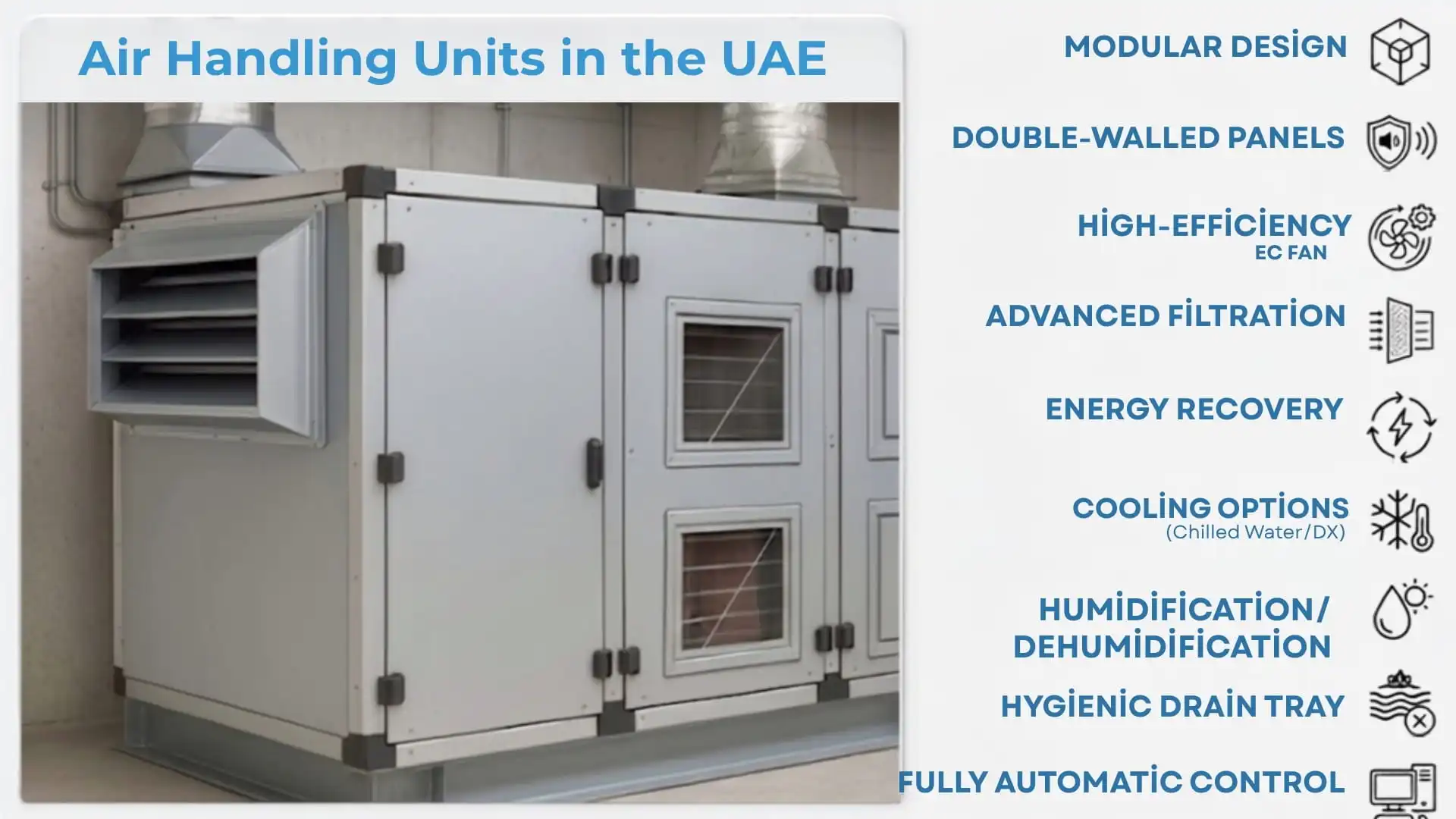
Key components of an AHU
An AHU is basically built around a few simple jobs. One part cleans the air before it moves through the building. Another part pushes the air forward. The unit can also warm the air in winter and cool it in summer. Some systems can remove extra moisture or add moisture when the air is too dry. There are some other parts that control how much fresh air comes in and how much used air goes out. In larger systems, you can see control systems that check room temperature, airflow and humidity.
Types of air handling units in Dubai and Abu Dhabi, UAE
Building type, required air quality and installation location are the key factors in finding the right AHU. Since a single unit can combine several characteristics, it helps to look at AHU types across four dimensions: function, construction, installation location and zoning.
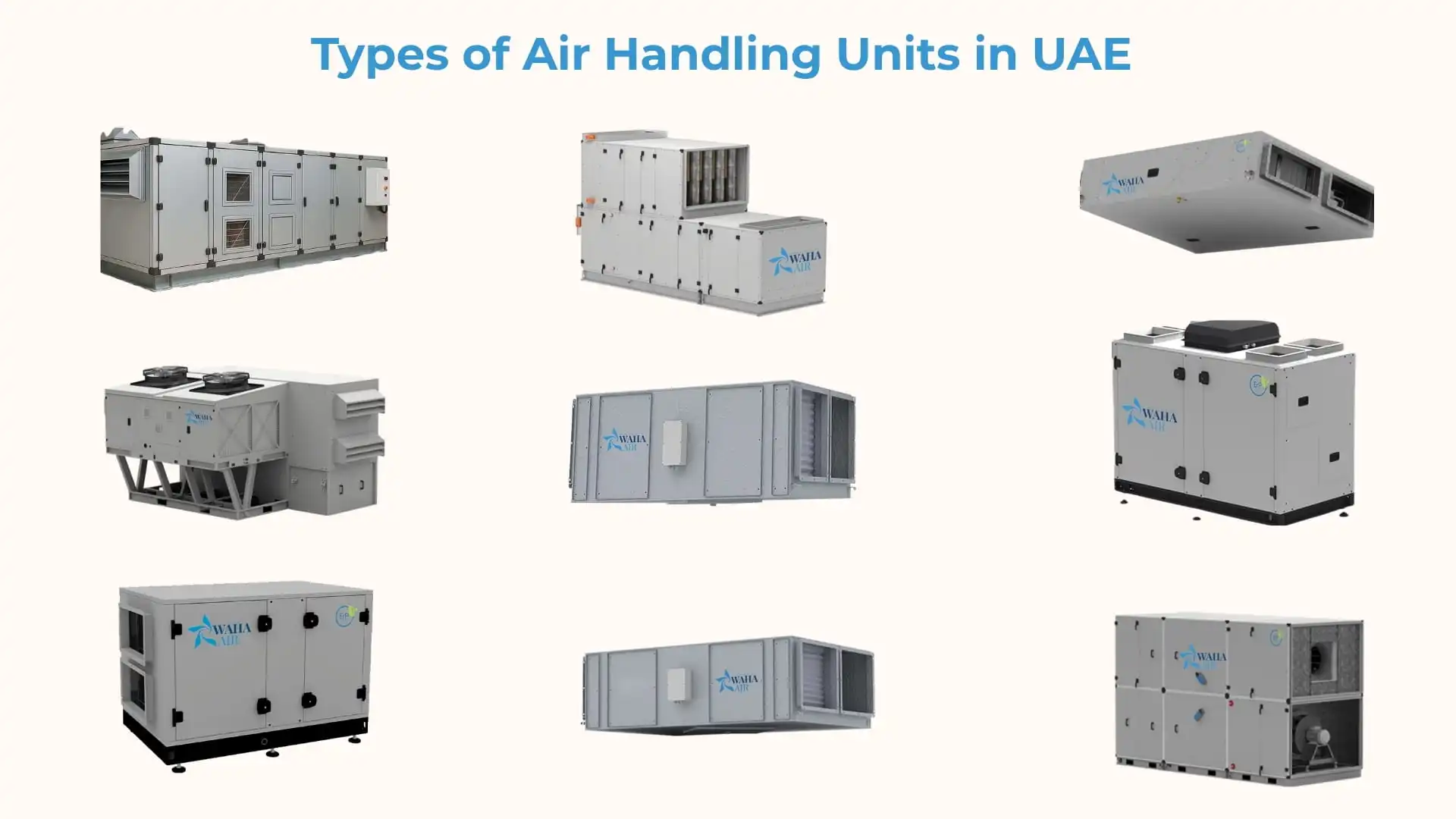
AHU types by function
Functional type determines what the unit actually does to the air — filter it, condition it, recover energy from it or simply move it.
Standard AHU
This is the common type used in offices, hotels, schools and shopping centres. It cleans the air, heats or cools it, and sends it through the building.
Fresh air AHU
This type mainly brings fresh air from outdoors into the building. It is more useful where good ventilation is important and you do not want to depend too much on reused indoor air.
Recirculation AHU
This system takes some of the indoor air, cleans it and uses it again. It reduces the amount of energy needed to heat or cool completely fresh air.
Heat recovery AHU
Heat recovery AHU in Abu Dhabi saves some of the heat or coolness from the air leaving the building and then uses that energy again. This is important to lower energy use.
Hygienic AHU
Hygienic AHUs are made for places where clean air is very important. They are commonly used in hospitals, laboratories, pharmaceutical plants and food production areas.
Make-up air unit
This type replaces air that leaves the building through exhaust systems. You often see it in kitchens, factories and industrial spaces.
AHU types by construction
Construction type affects how the unit is manufactured, delivered and assembled on site.
Modular AHU
A modular AHU is built from separate sections. You can add or change sections depending on what the building needs. This makes it useful for larger or more complex projects.
Packaged AHU
A packaged AHU comes as a more complete, ready-made unit. It is easier to install because many parts are already put together.
AHU types by installation location
Installation location influences space planning, weather protection and access for maintenance.
Rooftop AHU
This type sits outside, usually on the roof. It is a good option when there is not enough space inside the building.
Indoor AHU
Indoor AHUs in Dubai, are installed inside a plant room or another technical area. They stay protected from outdoor weather and are common in many commercial buildings.
Outdoor AHU
Outdoor AHUs are made to work outside. Their body and parts are designed to handle rain, wind, heat and cold.
AHU types by zoning
Zoning determines how many separate areas a single unit can serve, and how independently their conditions can be controlled.
Single-zone AHU
This unit serves one main area or one zone. It works well when that space has similar heating, cooling and ventilation needs.
Multi-zone AHU
A multi-zone AHU can serve different areas with different needs. For example, one part of a building may need more cooling while another needs less.
In practice, most AHUs combine characteristics from more than one category — for example, a hygienic AHU built in modular sections and installed on a rooftop. Identifying your building's functional needs, construction preferences, installation constraints and zoning requirements together leads to the most accurate unit selection.
AHUs in different sectors in UAE
Different places use AHUs for different reasons.
Commercial Buildings & Offices
AHUs help people work in a more comfortable space in offices. AHUs bring in fresh air, filter it and help keep the room temperature at a good level.
Hospitality (Hotels & Malls)
Hotels and malls are busy places. So, they need plenty of fresh air. AHUs offer cleaner and less heavy air to people. And they also provide a comfortable environment.
Healthcare & Labs
Hospitals and labs need cleaner air than most buildings. This is important for patients! AHUs filter the air and keep the temperature and humidity at normal levels. In some rooms, they also help control air pressure.
Industrial & Special Applications
Factories release heat, dust, smoke or strong smells. AHUs help move this air out and bring cleaner air in. Some production areas also need a certain temperature or humidity level to work properly.
How to choose the right air handling units in the UAE?
The selection of an air handling unit (AHU) in the UAE, begins with the building's air conditioning load and operational requirements. To determine the correct unit, the following parameter must first be clarified: what are the air flow rate and air conditioning capacity that the system must provide?
In applications where a high fresh air ratio is required, fresh air handling units are preferred.
If energy efficiency is a priority, heat recovery units come into play; these systems reduce total energy consumption by recovering thermal energy from the exhaust air.
In environments requiring a high hygiene class (such as operating theatres, cleanrooms and laboratories), air handling units with HEPA filtration and hygienic internal surface coatings become mandatory.
If mechanical room space is limited, rooftop or outdoor-type units provide installation flexibility. In buildings with multiple zones having different thermal loads, multi-zone or modular configurations are preferred. In projects where on-site installation time is limited, factory-assembled (packaged) units reduce commissioning time.
However, the choice does not end with simply selecting a type. Where the unit is installed also directly affects the outcome. The requirements in an office building are not the same as those in an operating theatre; each environment demands different levels of functionality and maintenance.
Before finalising your decision, consider the following points:
- Required airflow rate
- Available space and installation constraints
- Need for additional functions such as heating, cooling, filtration and humidification
- After-sales maintenance and service support
- Noise levels and energy consumption
- Ease of installation — single unit or on-site assembly
- Availability of factory-integrated control systems
The right air handling unit does more than simply condition the air; it reduces costs in the long term, simplifies installation and integrates seamlessly into the building's day-to-day operations.
Climate conditions across Dubai and the UAE, characterized by high outdoor temperatures and high humidity, make the selection of an AHU even more critical. Waha Air is by your side at every stage of the process—from selecting the correct capacity and configuration to post-installation technical support—with air handling unit solutions specifically designed for the region's challenging conditions.
Looking for an AHU installation and contractor in the UAE? Contact Waha Air to discuss your project.
Need a Ventilation Solution?
Get a free site survey and a tailored air distribution proposal from our engineering team.
Chat on WhatsApp