


Air-Cooled vs Water-Cooled Chillers in the UAE: How to Choose?
A chiller is a machine that produces chilled water to cool buildings and industrial equipment. It is widely used in hotels, hospitals, offices and factories. There are two main types of chiller systems: air-cooled and water-cooled. Both produce chilled water, but they reject heat in different ways.
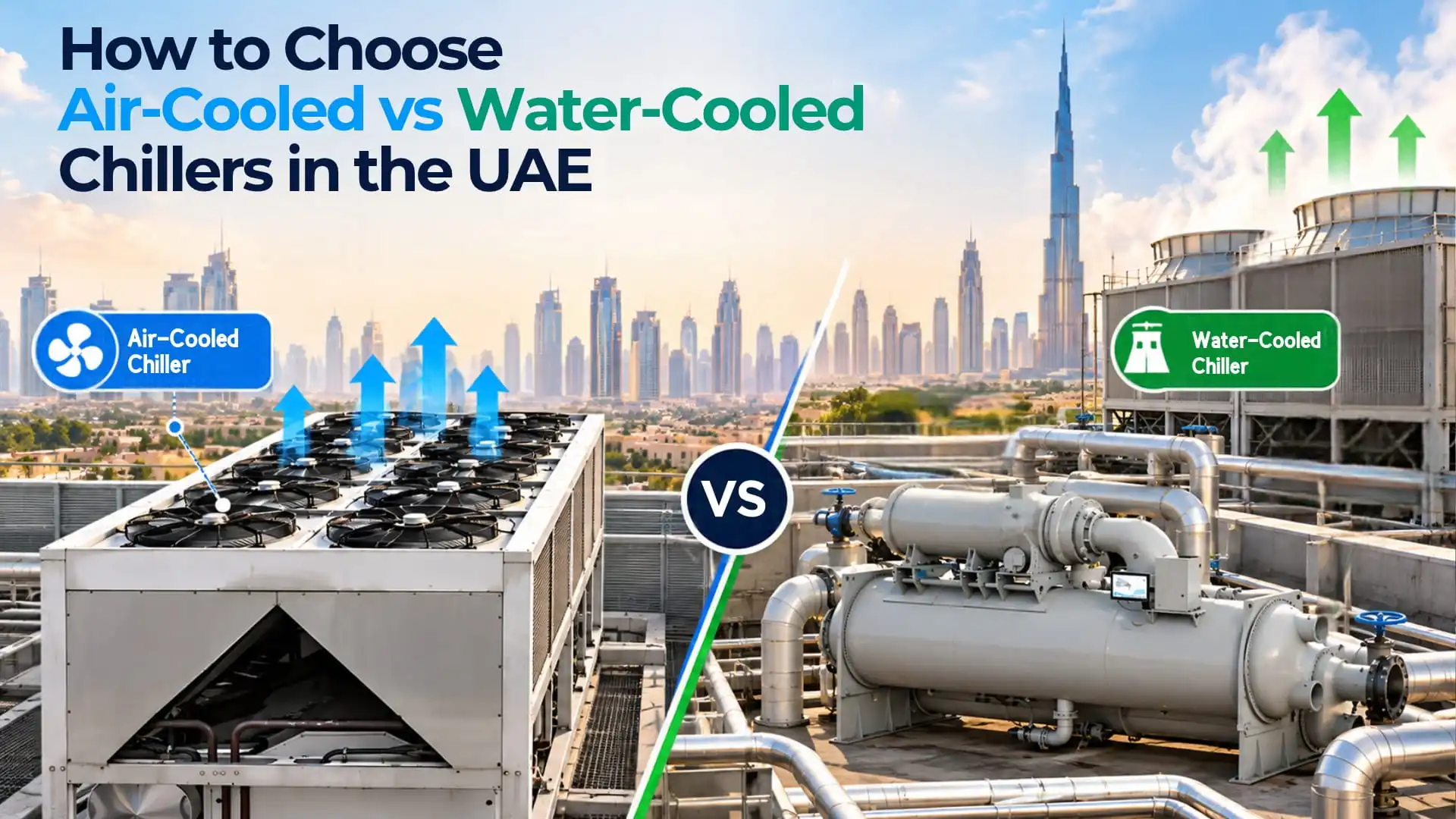
In the UAE, the choice between the two depends on your cooling load, running hours, available space and maintenance capacity. Air-cooled chillers suit projects that need quick installation and minimal infrastructure. Water-cooled chillers are generally more efficient for large, continuous cooling needs, but they require a cooling tower, water and regular care. In the UAE's extreme heat, the right choice improves cooling reliability and keeps energy costs under control.
This guide compares both systems to help you choose for your facility in Dubai, Abu Dhabi and across the UAE.
Not sure which chiller fits your building? Share your cooling needs and project details with Waha Air and get a technical recommendation from our engineers
What is an air-cooled chiller, and how does it work?
An air-cooled chiller uses fans to push outdoor air over a coil, moving heat from the building's water into the outside air. The compressor, condenser and other main parts sit in one unit. It does not need a separate cooling tower.
Air-cooled chillers are used in offices, clinics, hospitals, shopping centres, warehouses and industrial facilities. They are also suitable for temporary cooling, construction projects and emergency cooling needs.
Advantages
- Faster installation: Once electrical, water piping and control connections are ready, the system can be commissioned quickly.
- Less equipment: No cooling tower, condenser water pump or tower water treatment system is needed.
- Simpler maintenance: Fewer auxiliary parts generally mean a simpler routine for chiller servicing and maintenance.
- No tower water use: There is no evaporation loss from a cooling tower. The chilled water circuit still holds water, though.
- Lower first cost: Installation cost is usually lower than a water-cooled plant.
Disadvantages of air-cooled chillers
The primary disadvantages of air-cooled chillers include a loss of efficiency during extreme heat, the requirement for an open-air installation space, and a generally shorter service life. In the UAE, outdoor temperatures become very high during the summer months, making it difficult to reject heat into the environment; consequently, the system consumes more energy. Furthermore, because they operate outdoors, their lifespan is typically shorter than that of a well-maintained water-cooled chiller.
What is a water-cooled chiller, and how does it work?
A water-cooled chiller transfers heat extracted from a building’s chilled water loop into a separate condenser water loop. This water is then sent to a cooling tower, where a portion of it evaporates, releasing the heat into the atmosphere.
Water-cooled chillers in the UAE are used in hotels, hospitals, shopping malls, high-rise commercial buildings, campuses, and large manufacturing facilities that require significant cooling throughout the year.
Advantages of water-cooled chillers
- Better efficiency at scale: They can save energy in facilities with high cooling loads and long running hours.
- Stable temperature control: Chilled water temperature can be controlled closely, which helps production machinery and temperature-sensitive processes.
- Long equipment life: With proper maintenance, they can last longer than air-cooled units.
Disadvantages of water-cooled chillers
Water-cooled chiller systems require a cooling tower, water pumps, and additional piping, making their installation more complex than that of air-cooled systems. This equipment increases the initial investment cost and maintenance requirements. However, the energy savings they provide in large facilities and over the long term can reduce operating costs.
Air-cooled vs water-cooled chillers: comparison
| Feature | Air-Cooled Chiller | Water-Cooled Chiller |
|---|---|---|
| How it works | Rejects heat to outdoor air with fans | Rejects heat through water, usually with a cooling tower |
| Energy efficiency | Can drop in extreme heat | Often more efficient for large, continuous loads |
| Installation and infrastructure | Faster, no cooling tower needed | Needs a tower, pumps and extra piping |
| Cost | Lower first cost | Higher first cost, may save energy over time |
| Water and maintenance | No tower water, fewer auxiliary parts to maintain | Uses water, needs tower, pump and water treatment care |
| Space | Needs open space and good airflow | Chiller can be compact, but tower and pumps need space |
| Performance in UAE heat | Affected by high outdoor temperatures | Depends on water temperature and humidity |
| Best for | Small and mid-size sites | Large sites with constant cooling needs |
Looking for air-cooled or water-cooled chillers in Dubai or elsewhere in the UAE? Explore Waha Air's chiller solutions, featuring equipment from leading brands such as Daikin, York, Trane, Carrier and SKM.
Air-cooled vs water-cooled chiller cost Dubai, UAE
Air-cooled chillers usually cost less to install. Water-cooled chillers can cost less to run when they work long hours. To compare fairly, look at the full lifetime cost, not the purchase price alone.
| Cost item | Air-Cooled | Water-Cooled |
|---|---|---|
| First cost (equipment and installation) | Lower | Higher (tower, pumps, piping) |
| Energy cost | Higher in extreme heat | Often lower for large, steady loads |
| Water and treatment | No tower water | Makeup water and treatment |
| Maintenance | Fewer parts to service | Tower, pumps and water treatment need regular care |
| Replacement | Typically earlier | Typically later, with good maintenance |
A hotel that runs its chiller almost non-stop may recover the extra investment of a water-cooled plant through lower energy use. However, the same savings may not be achievable in a small office with shorter operating hours.
Would you like to find out which chiller system is more economical for your facility in Dubai, Abu Dhabi, or the UAE? Contact Waha Air, and our technical team will assess your cooling needs and help you identify the system and cost options best suited for your project.
How do UAE conditions affect the choice?
- Extreme heat: Air-cooled units must reject heat into very hot outdoor air at peak summer. Check the model's rated capacity at high ambient temperatures.
- Humidity and water temperature: A water-cooled system's performance depends on cooling tower conditions, including humidity.
- Water use and quality: Cooling towers need makeup water and treatment. Plan for both, and follow the requirements that apply to your site and emirate.
- Dust and sun: Both systems need clean heat exchange surfaces. Dust on coils or tower fill reduces performance.
5 questions to choose the right chiller
- How many hours will it really run? A water-cooled plant earns back its extra cost only through long running hours. A chiller that works a few hours a day rarely reaches that point.
- What does your site allow? Check roof or plant room area, floor loading and pipe routes first. A tower and pumps need room, and an air-cooled unit needs clear airflow. The site often settles the question before the budget does.
- Who will look after it? A water-cooled plant needs a trained operator and a routine. If your team is small, a simpler air-cooled unit with a service contract often outperforms a neglected water-cooled one.
- What will it cost over its whole life? Price the purchase, energy, water, treatment, servicing and replacement together. The cheapest installation is not always the cheapest chiller to own.
- Do you need a chiller at all? For small and mid-size buildings with zones that vary, a VRF system (a refrigerant-based system with zone control) may do the job with simpler plumbing. Compare it before you commit. See our guide: VRF vs Chiller Systems in the UAE.
Planning a Chiller Plant?
Get a free consultation and a tailored chiller system proposal from our engineering team.
Chat on WhatsAppFrequently asked questions
Water-cooled chillers are generally more efficient, and the gap tends to widen as outdoor temperatures rise. A cooling tower rejects heat through evaporation, so it is less affected by dry heat. The advantage holds only with proper water treatment and tower cleaning, and savings depend on running hours.
It usually costs less to install, because it needs no cooling tower, condenser pumps or extra piping. Over its life, a water-cooled chiller can cost less if it runs long hours. Compare all costs across the equipment's life.
Most do. The tower rejects the heat to the atmosphere. Special cases may use other heat sinks, such as a dry cooler. A tower needs makeup water, water treatment and regular cleaning.
They need no cooling tower makeup water. The chilled water loop still holds water in a closed circuit, which may need filling, treatment or an occasional top-up.
Yes, if the model is rated for peak summer ambient temperatures and still delivers the required capacity at your chilled water temperature. Ask for performance data at high ambient conditions before you buy.
It is possible, but rarely simple. You need space for a tower and condenser pumps, condenser water piping and drainage, and enough structural and electrical capacity. Most HVAC retrofits keep the original heat-rejection method and gain efficiency by replacing old equipment with modern units.
Air-cooled chillers commonly last 15-20 years. Water-cooled chillers can last 20-30 years with proper maintenance. In the UAE's heat and dust, clean heat exchangers, correct water treatment and a maintenance contract make the biggest difference.
Yes. Waha Air supplies, installs and maintains chiller systems and offers annual maintenance contracts in Dubai and across the UAE.