


VRF vs. Chiller System: Which HVAC system is best in the UAE?
Chillers and VRF systems in the UAE are the two main HVAC solutions used to meet the climate control needs of large buildings. The key difference between them is that chiller systems distribute cooling via water, whilst VRF systems do so via a refrigerant. Offering high energy efficiency at partial loads and flexible installation, VRF systems stand out as a strong option in many commercial projects. Conversely, in buildings requiring very high cooling capacity, chiller systems may prove more economical due to their long-term operating costs and economies of scale.
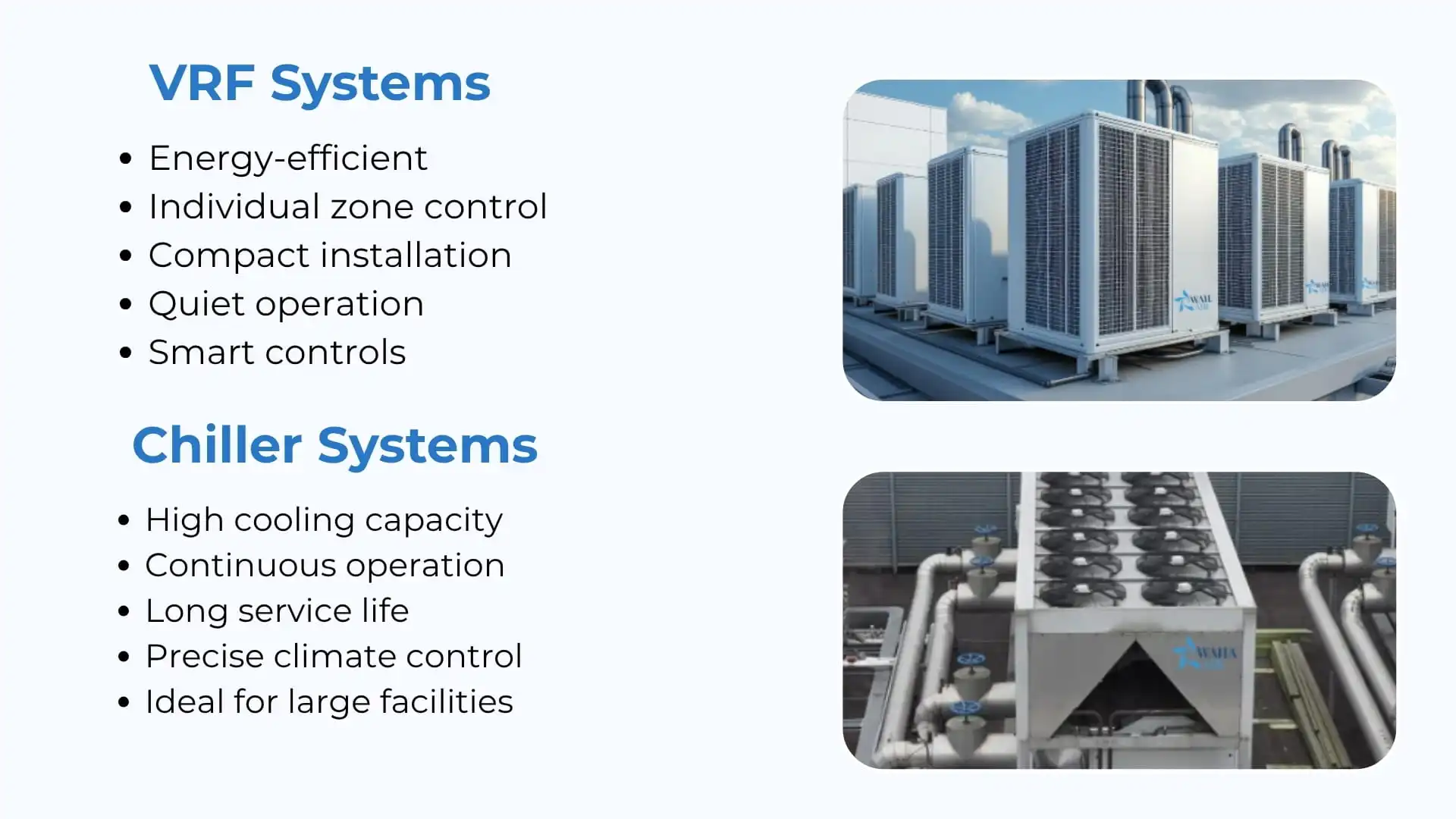
Choosing the right system depends on the building size, cooling load, energy targets, investment budget, and maintenance strategy. This article will help you make a more informed decision by comparing the basic information, advantages, disadvantages, and conditions.
About VRF and Chiller systems in the UAE
VRF system
A VRF (Variable Refrigerant Flow) system sends refrigerant directly to the indoor units and independently controls the temperature of each room. This design provides high energy efficiency and flexible use for hotels, offices, villas, and medium-sized commercial buildings.
Chiller system
A chiller system cools water in a central unit and distributes this water to the building via an AHU (Air Handling Unit) or FCU (Fan Coil Unit). Thanks to its high capacity, it is a more suitable solution for projects requiring continuous cooling, such as shopping malls, hospitals, factories, and high-rise buildings.
Comparison of VRF and Chiller systems in the UAE
| Comparison Criteria | VRF System | Chiller System |
| Cooling Medium | Refrigerant (DX system) | Chilled water |
| Operating Principle | Refrigerant is delivered directly to indoor units. | Chilled water is distributed through AHUs and FCUs. |
| Control | Individual zone control for each space. | Centralized control system. |
| Energy Efficiency | Highly efficient under partial-load conditions. | More efficient for large and continuous cooling loads. |
| Capacity Control | Inverter-driven operation adjusts output to demand. | Uses staged or on/off compressor control. |
| Installation | Faster installation with less infrastructure. | Requires more mechanical infrastructure and longer installation time. |
| Space Requirements | No dedicated plant room is required. | Requires a plant room, pumps, and often a cooling tower. |
| Maintenance | Lower maintenance requirements. | Higher maintenance due to water circuits and mechanical equipment. |
| Initial Investment | Lower upfront cost for small and medium-sized projects. | Higher initial investment. |
| Operating Cost | Energy-efficient under variable loads. | More cost-effective for large-capacity, long-term operation. |
| Best Applications | Hotels, offices, apartments, and villas. | Hospitals, shopping malls, universities, and industrial facilities. |
Pros and Cons of VRF systems vs. Chiller systems in Dubai, UAE
Advantages of VRF systems
- It can provide up to 40% energy savings compared to traditional air conditioning systems.
- It can operate at different temperatures for each room or area.
- It requires less space for installation.
- It operates quietly and increases indoor comfort.
- Thanks to its flexible installation structure, it can be easily adapted to hotels, offices, apartments, and renovation projects.
- It is easy to maintain and does not require water treatment or chemical maintenance. This reduces maintenance time and cost.
- It can be monitored and controlled remotely via a mobile application or building management system (BMS).
- It is designed to operate efficiently even at high temperatures.
Disadvantages of VRF systems
- VRF systems may not be as efficient as central chiller systems in large buildings requiring very high and continuous cooling loads.
- The length of the refrigerant pipes and the height difference between the indoor and outdoor units must be within certain limits.
- Installation and maintenance by expert technicians are required.
- A leak in the piping can reduce system efficiency and increase repair costs.
- A malfunction in the main outdoor unit can affect the operation of multiple connected indoor units.
- The control system is sensitive; incorrectly configured control settings can prevent the system from performing as expected.
Advantages of Chiller systems
- Ideal for large buildings, hospitals, shopping malls, and manufacturing facilities that require high cooling capacity.
- With proper maintenance, it can operate reliably for 20-30 years or more.
- Provides efficient cooling under continuous and high load.
- Thanks to the AHU (Air Handling Unit), temperature, humidity, and air quality are controlled more precisely.
- Offers low long-term operating costs in large-scale projects.
Disadvantages of Chiller systems
- Initial costs are high due to infrastructure systems such as cooling units, air conditioning systems, pipelines, and cooling tower installation.
- Requires a large installation area.
- Energy consumption may be higher than VRF systems when operating at low capacity.
- Maintenance may be more expensive than VRF systems.
VRF vs. Chiller System: How to choose the right system for your building?
When choosing the right air conditioning system in the UAE, you should consider the following criteria.
- Building size: VRF systems are more suitable for small and medium-sized buildings, while chiller systems are more appropriate for large commercial and industrial structures.
- Cooling load: VRF is more efficient for variable and partial loads. Chiller systems excel in applications requiring continuous and high capacity.
- Comfort needs: If each room needs to operate at a different temperature, a VRF system offers more control. If precise temperature, humidity, and air quality are required, an AHU-supported chiller system is more successful.
- Installation space: If mechanical rooms and technical areas are limited, a VRF system provides an advantage. Chiller systems require a larger infrastructure.
- Budget: VRF systems are preferred for lower initial investment. In large projects, however, a chiller system may be more economical in the long run due to its lower operating costs. To get an accurate forecast, it is best to consult an experienced HVAC engineering consultant in Dubai for a detailed life-cycle cost analysis.
- Maintenance possibilities: VRF systems are easier to manage in buildings without a regular technical team. Chiller systems, on the other hand, offer high performance for many years with scheduled maintenance.
- Future growth plan: If the project is expected to increase capacity in the future, modular chiller systems or hybrid solutions can be considered.
There is no single 'best' option when choosing between VRF and chiller systems in Dubai. The right choice depends on the size of your building, the cooling load, the intended use and your long-term operational objectives. The aim is to select a system that will operate efficiently not just today, but for years to come. Therefore, choosing WAHA AIR, a leading HVAC company in the UAE, provides a significant advantage in terms of system performance and energy efficiency.
As a premier provider of turnkey HVAC solutions in Dubai, UAE, WAHA AIR is uniquely positioned to handle these setups. For long-term solution proposals regarding both VRF and commercial HVAC projects in Dubai, please contact us.